
Affiliate Disclosure: This article contains affiliate links. If you purchase through these links, I may earn a commission at no additional cost to you.
When I launched AH Web Works, I didn’t have any articles prepared, established search rankings, or a large audience.
Like many website owners, I started with a simple goal: to create useful content that could help small business owners, entrepreneurs, and website creators build a stronger online presence.
At the time, the website contained only a handful of basic pages and minimal content.
Over the following months and years, that small collection of pages gradually grew into a much larger library of articles covering WordPress, hosting, website builders, ecommerce, SEO, digital marketing, and various online business topics.
Today, after publishing more than 70 articles on WordPress.com, I’ve learned valuable lessons about content creation, website management, search engine optimization, and the realities of constructing a website over time.
This article shares some of the most important lessons I learned throughout my journey.
Table of Contents:
Starting With an Empty Website
The thing that surprised me most early on was how difficult it actually is to start a website from scratch.
When AH Web Works first went live in April of 2025, there wasn’t much content available for visitors to explore.
The site had a few foundational pages, but very little that could attract traffic through search engines.
At that stage, every article felt important.
Each new piece of content was another opportunity to answer questions, solve problems, and establish authority within the website-building niche.
I remember spending considerable time researching which topics to cover and how to organize the site’s structure.
Looking back, I realize that many of those concerns were less important than I thought.
The most important thing was simply getting started.
One lesson I learned very quickly is that consistency matters more than perfection.
Publishing useful content regularly seems to create better long-term results than endlessly refining a single article.
Developing a Publishing Workflow
As the number of articles began increasing, I found myself needing to create a more organized publishing process, and way of keeping track of my keywords.
Fortunately, WordPress.com made that straightforward.

The Posts dashboard quickly became one of the sections I visited most often.
It allowed me to manage drafts, update existing articles, review published content, perform quick edits and maintain the overall structure of the website from a centralized location.
What impressed me was how manageable everything remained as the content library continued expanding.
Whether I was updating a recently published article or revisiting a piece that was over a year old, finding and editing content remained very simple.
That may seem like a small advantage, but it becomes increasingly valuable as a website grows and there is more content to manage.
The difference between managing ten articles and managing seventy articles is significant.
Having a reliable workflow helps prevent content from becoming a mess and difficult to maintain.
What Surprised Me About Content Creation
One of the biggest surprises I encountered was discovering how much work is required after an article is published.
Many new website owners assume that publishing an article marks the end of the process.
In reality, it is just the beginning.
Articles need updates.
Screenshots become outdated.
Information and dates change.
Internal links need improvement.
New opportunities emerge to expand and improve existing content.
Some of the articles on AH Web Works look very different today than they did when they were first published.
As my understanding of SEO and website management improved, articles and content also improved in relation to my new understandings.
This taught me an important lesson:
Successful content is never finished.
Instead, it should grow and improve over time.
Learning the Importance of Internal Linking
If there is one area where I would have paid more attention to earlier, it would be internal linking.
When I first began publishing content, most articles existed independently from each other.
Each article focused on its own topic, but there were relatively few established connections between related pieces of content.
Eventually, I started building a stronger internal linking structure.
A website builder article could connect readers to hosting recommendations.
A hosting article could link to WordPress tutorials.
An ecommerce guide could direct visitors toward WooCommerce resources.
These connections helped readers discover additional content while also creating a more organized website structure.
Today, internal linking plays a major role in how I manage content.
It improves navigation, encourages deeper engagement, and helps connect related topics across the website, and increases views overall.
Looking back, I would have prioritized this much sooner.
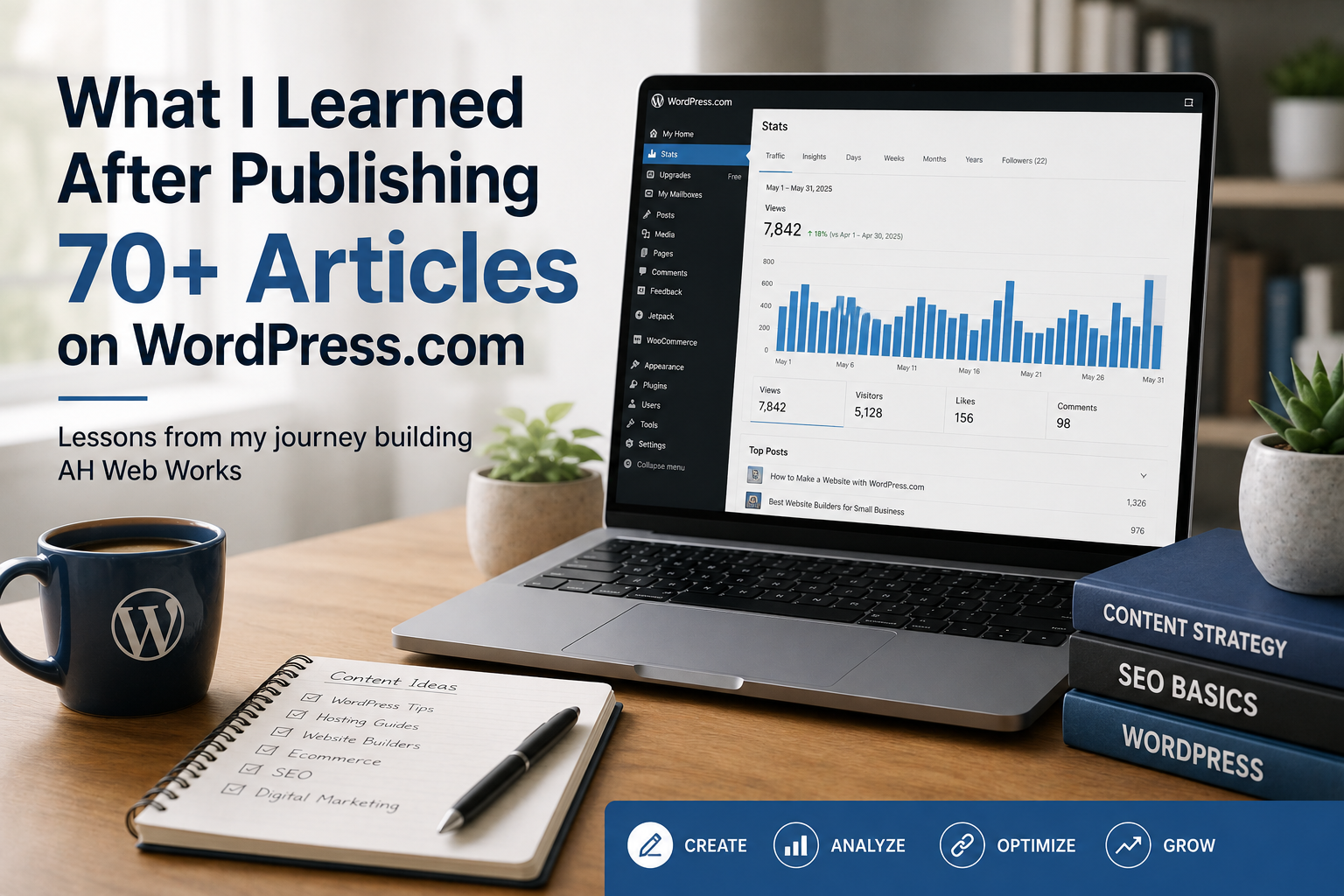
Using WordPress.com Stats to Measure Progress
One of the tools I have used most consistently throughout this process is WordPress.com Stats.

The stats dashboard provided helpful insight into how visitors were interacting with the website.
It allowed me to identify which articles generated interest, which topics attracted readers, and how traffic patterns evolved over time.
Perhaps more importantly, it taught me patience.
Website growth rarely happens in a straight line.
Some articles attracted attention quickly.
Others took months before search engines began sending meaningful traffic.
There were periods where growth seemed slow and periods where progress accelerated unexpectedly.
The stats dashboard helped me maintain perspective during both those times.
Even small increases in traffic often indicated that the overall strategy was moving in the right direction. And I could use those insights to direct my focus.
Managing Images and Media
As the website expanded, so did the number of images, graphics, screenshots, and media files.
What began as a simple website slowly accumulated a substantial media library.

Featured images, comparison graphics, tutorial screenshots, and article illustrations all needed to remain organized.
The Media Library became increasingly important as the site grew.
One thing I appreciated about WordPress.com was having a centralized location where all media assets could be stored and managed efficiently.
This made it much easier to update older content, replace outdated images, and maintain consistency throughout the website. It also helped save a tremendous amount of space on my hard drive.
Without a strong media management system, maintaining a large content library would be significantly more challenging.
My Experience With the WordPress.com Editor
The editor is probably where I’ve spent more time than anywhere else on the platform.

After publishing dozens of articles, I became intimately familiar with blocks, headings, images, lists, buttons, and layout tools.
When I first started using the block editor, there was definitely a learning curve.
Over time, however, I came to appreciate how flexible, efficient and visual the experience could be.
Rather than focusing on technical implementation, I could focus on visualizing and creating content.
The editor allowed me to structure articles efficiently while still providing plenty of design flexibility.
For a content-focused website like AH Web Works, that balance has been super valuable.
The Reality of Search Engine Growth
Another lesson I learned is that search engine growth often requires far more patience than most expect.
When publishing early articles, it’s easy to assume that traffic will arrive immediately.
In reality, many articles take a significant amount of time to gain visibility.
Some content may not receive meaningful traffic for months.
Other articles can surprise you and perform much better than expected.
The important thing is continuing to publish useful content while regularly improving the website over time.
One of the benefits of having a larger content library is that every new article strengthens the website.
Each article creates additional opportunities for visitors to discover and interact with your content.
Over time, those opportunities begin to compound.
What I Would Do Differently Today
Looking back, there are a few things I would change if I were starting over.
I would establish a stronger and more organized site structure earlier.
I would create more internal links from the beginning.
I would spend more time updating existing content.
I would develop content clusters sooner.
And perhaps most importantly, I would worry less about short-term traffic fluctuations.
Many lessons only become obvious after publishing a substantial amount of content.
That’s simply part of the learning process.
Every website owner eventually develops a deeper understanding of what works through experience.
The Biggest Lesson I Learned
If there is one lesson that stands above everything else, it is this:
Consistency matters.
Publishing a single excellent article can be helpful.
Publishing dozens of useful articles over time can completely transform a website.
The websites that succeed are often the ones that continue showing up, improving content, and serving readers long after the initial excitement has faded.
WordPress.com provided the tools I needed to support that process, but the real progress came from consistent effort and regular improvement.
Final Thoughts
Publishing more than 70 articles on WordPress.com has taught me a lot than I expected when I first launched AH Web Works.
I’ve learned about content creation, SEO, website organization, internal linking, analytics, media management, and long-term growth.
Most importantly, I’ve learned that successful websites take time to grow.
They develop gradually through consistent effort, useful content, and ongoing updates.
For anyone considering WordPress.com as a platform for publishing content and growing a website, my experience has been overwhelmingly positive.
It has allowed me to focus on creating useful resources while providing the tools needed to manage a growing content library efficiently.
If you’re considering launching your own blog, business website, portfolio, or online resource center, WordPress.com provides an excellent balance of simplicity, flexibility, and scalability.
Best next step: WordPress.com is a practical fit for publishers who want to focus on content while hosting, security, and updates are handled.
Disclosure: AH Web Works may earn a commission if you purchase through this link, at no additional cost to you.

What are your thoughts?