

Disclosure: This post contains affiliate links. If you purchase through these links, I may earn a commission at no extra cost to you.
Starting the new year out with fresh upgrades and optimizations is an urge for many. For many website owners, that feeling isn’t about adding further complexities. It’s about the desire for things to feel simpler, clearer and more smoothly operating.
As website age, they have a tendency to accumulate a mass amount of pages, features, plugins and ideas that at one point made sense, but are no longer serving a valid purpose. Often times, this accumulation of unneeded features can make a website perform in a heavier manner, make it harder to update and more challenging to feel comfortable about.
A digital reset can serve as an opportunity to step back and reasses. Your primary lens should be removing as much friction as possible and simplifying things, so your website can better support your goals in the years ahead.
Table of Contents:
- What a Digital Reset Actually Means for a Website
- Signs Your Website Is Ready for a Reset
- Start With Purpose Before Making Changes
- De-cluttering Your Website Without Breaking It
- Simplifying Tools, Plugins, and Features
- Creating a Sustainable Website Setup for 2026
- Small Improvements That Add Up Over Time
- Common Digital Reset Mistakes to Avoid
- Final Thoughts: Starting the Year With Clarity
What a Digital Reset Actually Means for a Website
A digital reset doesn’t need to be complicated, it doesn’t mean starting over or completely rebuilding your platform. In most cases, it means stepping back and taking a good look to see what’s already there.
Rather than adding complexity, a digital reset should focus on clarity. It’s to ask the question, does your website still reflect your goals and what you plan to accomplish? It’s good to make sure that your website’s priorities are in check and focused. It’s ok to reassess your goals, create new ones, and focus in on your list.
In 2026, your website should feel seamless, intentional, easy to manage, and aligned with its focused purpose. Simplifying what already exists often produces more optimal results than introducing something completely new.
Signs Your Website Is Ready for a Reset
It’s not always obvious when a website may need a reset, though in most cases, the signs appear gradually rather than all at once. Sometimes issues start as a minor inconvenience and then quietley turn into obvious friction that makes your site harder to manage, more tricky to update and more stressful to maintain.
If your website feels more fragile than usual, a reset is worth considering.
Common Signs a Reset May Be Needed:
- Your site feels obviously slower, even though no new features or content has been added.
- Updates are more complicated because you always expect something to break afterwards.
- You are relying on multiple services with different accounts to maintain your website’s foundation (operation, security and updates).
- Repetitive issues are present, even when they have been fixed shortly before.
- The WordPress admin dashboard feels discombobulated.
- There are frequent issues with older and new plugins.
- Performance enhancements feel unreliable and/or temporary.
- Website maintenance is consuming a large amount of time.
- You are hesitating to make upgrades, or add new features because you are worried they might break things.
Why a Reset Is Often Less Risky Than Doing Nothing
Many website owners assume that fixing their website’s little issues will be complicated, risky and/or expensive. So, they tolerate the issues far longer than necessary.
A digital reset does not mean starting all over again blindly. It means perfecting the foundation through simplicity and reducing technical challenges. A reset should ultimately restore your confidence in your website, and be a simple way to reach your goals more seamlessly and efficiently. Ultimately, providing you with more overall joy in operating and adding to your website the things that truly matter.
If your website is not feeling optimal, that signal is usually something to listen to.
Start With Purpose Before Making Changes
One of the most important things you can do prior to a digital reset is clarifying your purpose and goals before taking action.
Before doing anything to your website, it helps to clarify what role your website should play in 2026. Is it meant to inform, supplement your business, publish articles, or simply exist as a sort of business card?
Before making ANY changes, it can help to reflect on a few questions:
- What is the main role of my website right now?
- Who is the site meant to serve?
- Which pages or features actively support that purpose?
- What feels outdated, or no longer serving a purpose?
When your goals are clear, decisions about what to keep and what to eliminate become much easier. Without clarity, digital resets can turn into a larger challenge.
De-cluttering Your Website Without Breaking It
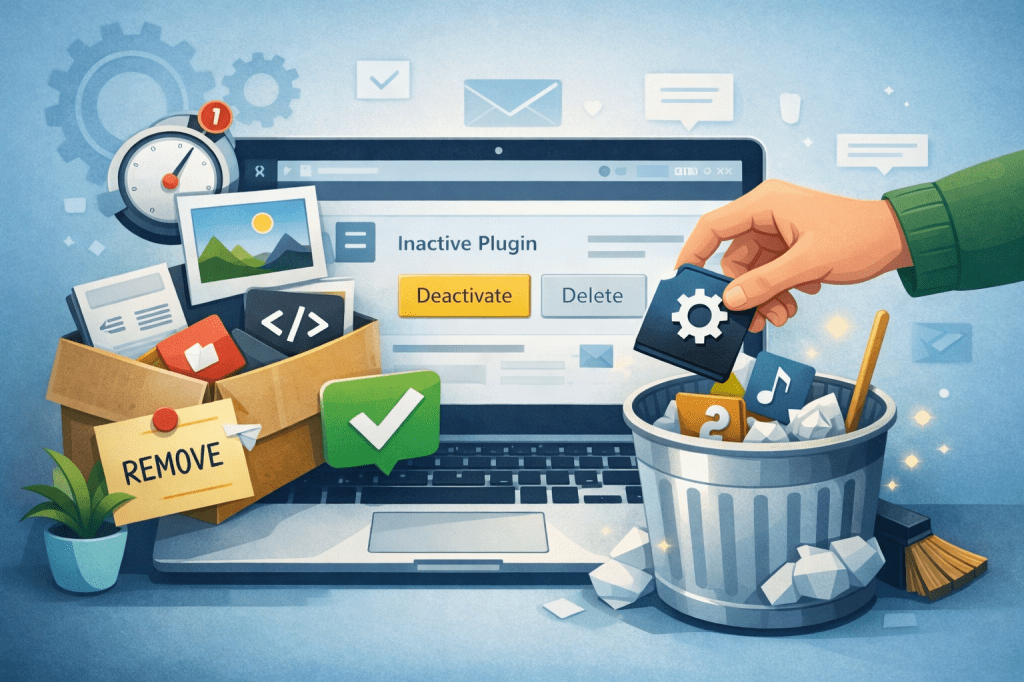
One of the most relieving and effective components of a digital reset is removing things that are no longer serving a good purpose.
It is easy to scan through your website’s set up and get an idea of what is no longer needed. It could be random unused plugins, features you forgot you installed and no longer need, old installed themes and/or tools you once needed but no longer do. Each extra unneeded feature adds a small amount of complexity to your website’s engine, even if it’s not being actively used. Removing them reduces maintenance risk and makes your site much simpler to run and understand.
This process should not be rushed. Removing one or two unnecessary features/plugins at a time is often safer than attempting to do bulk amounts all at once. Your goal in a digital reset should be to create breathing room, not add layers of complexity.
Simplifying Tools, Plugins, and Features
This year, websites benefit from fewer tools that do more, instead of an entire toolbox of ones that overlap in function.
In recent years, hosting platforms have improved drastically. Many features that at one point required separate plugins are now built directly into all-in-one environments. Automatic updates, built in back-ups, performance enhancements and integrated security all reduce the need for constant manual effort.
Going into 2026, simplicity is a great strength. A website that runs leaner is more predictable, easier to update, and far less likely to break during routine updates and changes.
Creating a Sustainable Website Setup for 2026
Sustainability is often never considered when running a website, but it does play a major role in long-term success.
A sustainable website setup in 2026 should prioritize:
- simplicity over customization
- Stability over tons of optimization
- Clear structure over fancy feature density
- Systems that run themselves and require less manual intervention
When a website is easier to maintain, it’s far more likely to remain useful over a longer period of time. Sustainability allows your website to support your goals without demanding constant attention.
Small Improvements That Add Up Over Time
A digital reset doesn’t need to take place all at once. Over time, small, thoughtful improvements tend to compound.
Updating your content for clarity, improving your site’s navigation, simplifying its layout and refining your messaging can all transform how your website runs and feels. These changes are often less disruptive and make your site easier to maintain than large overhauls.
Progress is more sustainable when it’s slow and gradual, rather than rushed.
Common Digital Reset Mistakes to Avoid
Even with the best intentions, digital resets might produce new problems if they are rushed or unplanned.
Common digital reset mistakes include:
- Rebuilding everything too quickly in bulk
- Chasing design and functional trends
- Resetting without a clear and planned purpose
- Adding on layers of complexity rather than removing it
A successful digital reset emphasize restraint and simplicity. Knowing what not to change is just as important as knowing what to change.
Final Thoughts: Starting the Year With Clarity
A digital reset does not need to be overly dramatic to be effective.
A new year doesn’t require a full website rebuild. In most cases, it simply requires making your current one clearer. By focusing on simplifying, purpose and sustainability your website can forge into 2026 as a tool that supports your goals rather than distracting from what truly matters.
Often times, the most meaningful improvement you can do is simply removing what is no longer serving you. A calm and intentional reset can make everything that follows much simpler.
If part of your digital reset includes simplifying hosting, updates, or long-term maintenance, managed platforms like WordPress.com can help you reduce technical overhead while keeping everything in one place. For many website owners, removing that layer of complexity makes it easier to focus on content, clarity, and growth instead of ongoing maintenance.
 AH Web Works
What do you think?